Most dental practices in your city are doing good work. Clean clinic, experienced staff, happy patients. But when someone searches “dentist near me” on Google, your practice does not show up.
That is frustrating. And the reason is often not what you think.
It is not always about your website. It is not always about ads. Many times, the missing piece is something simpler: local citations.
In this article, you will learn exactly what local citations are, why they matter specifically for dental practices, and how you can use them step by step to climb Google’s local rankings and start appearing where your patients are already searching.
Whether you are a solo dentist running your own clinic or managing a multi-location dental group, this guide will give you a clear, practical roadmap.
What Are Local Citations for Dentists?
A local citation is any online mention of your dental practice that includes your business name, address, and phone number. SEO professionals call this combination NAP (Name, Address, Phone).
It does not always have to be a full directory listing. Even a simple mention of your clinic’s name and phone number on a local news website or a community blog counts as a citation.
For example, if your practice is listed on Google Business Profile as:
Smile Care Dental Clinic | 42 Park Street, Austin TX 78701 | (512) 000-1234
Then that same information appearing on Yelp, Healthgrades, or the Austin Chamber of Commerce website is a local citation.
For dentists specifically, citations appear in three main places:
General business directories like Yelp, Yellow Pages, and Foursquare recognize your practice as a real, operating local business.
Healthcare and dental-specific directories like Healthgrades, Zocdoc, WebMD, and Vitals tell Google that your practice belongs in the healthcare space, which adds topical authority on top of local relevance.
Local and regional sources like your city’s Chamber of Commerce, local news mentions, or dental association websites give you hyper-local signals that Google’s algorithm values highly for “near me” searches.
Together, these three types of citations build a consistent, trustworthy digital footprint for your practice across the web.
Why Do Citations Matter for Dental SEO?
Google has one main job: show the most trustworthy, relevant result to the person searching. When someone types “dentist near me” or “teeth whitening in Austin,” Google needs to quickly decide which dental practices deserve the top spots.
Citations are one of the key signals Google uses to make that decision.
Here is the simple logic behind it. When your dental practice is mentioned consistently across dozens of trusted websites, Google sees that as proof that your business is real, established, and worth recommending. It is similar to word of mouth, but in a digital form.
Related Post: 10 Local Link Building Strategies That Actually Work
How exactly do citations influence your rankings?
Google’s local search algorithm has three core ranking factors: relevance, distance, and prominence. Citations directly impact prominence, which is essentially how well-known and trusted your practice appears online. The more high-quality citations you have, the more prominent Google considers you to be.
This is especially important for the Google Local Pack, which is that box showing three local businesses at the top of search results with a map. Studies by Moz and BrightLocal have consistently shown that citation signals are among the top factors influencing local pack rankings. For dental practices, getting into that three-pack can mean the difference between a fully booked appointment calendar and an empty waiting room.
There is another angle too. Many patients do not just search on Google. They check Healthgrades before booking a dentist. Read Yelp reviews and look up profiles on Zocdoc. If your practice is not listed on these platforms, you are invisible to a large segment of potential patients who are actively ready to book.
Citations also help with trust at the patient level, not just the algorithm level. A dental practice with a complete, consistent profile across multiple trusted health directories simply looks more credible than one with a sparse or missing online presence.
Which Citation Sources Work Best for Dental Practices?
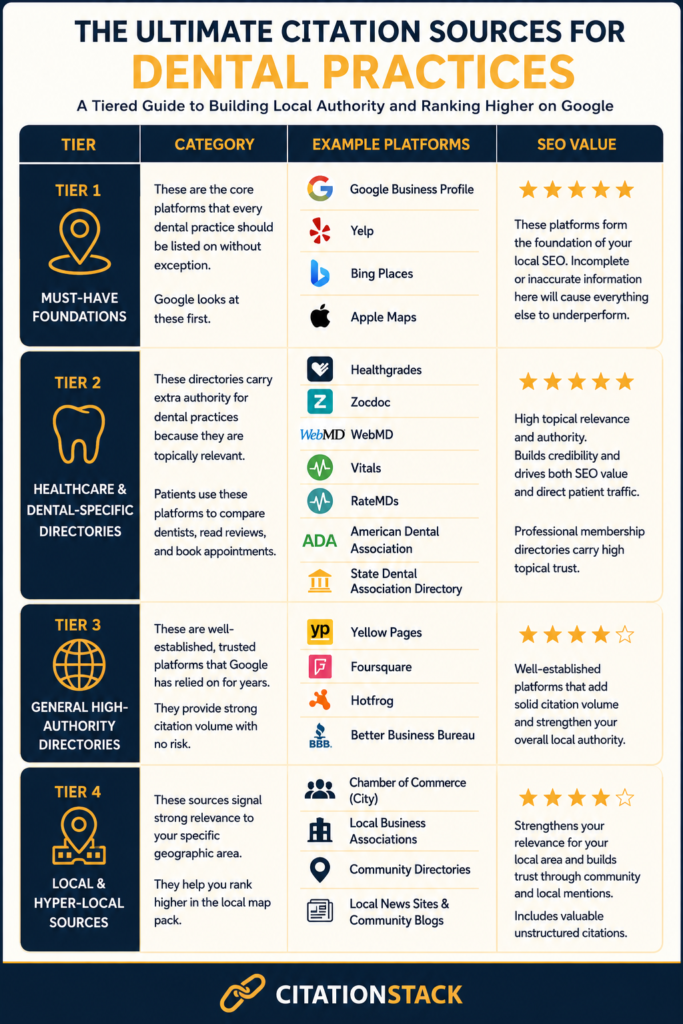
Not all citation sources carry the same weight. A listing on a high-authority, relevant directory does far more for your Google rankings than ten listings on low-quality or spammy websites. For dentists, the goal is to be present on platforms that Google already trusts and that patients actually use.
Here is a practical breakdown of the best citation sources for dental practices.
Tier 1: Must-Have Foundations
These are the core platforms that every dental practice should be listed on without exception. Google looks at these first.
Google Business Profile is the single most important listing you will ever create. It is not just a citation; it is your entire local SEO foundation. Your name, address, phone number, hours, photos, and reviews all live here. If this profile is incomplete or inaccurate, everything else you do will underperform.
Yelp, Bing Places, and Apple Maps round out the essential foundation. A large number of patients, especially iPhone users, find local businesses through Apple Maps without ever opening Google. Ignoring it means missing a real segment of your local audience.
Tier 2: Healthcare and Dental-Specific Directories
These directories carry extra authority for dental practices because they are topically relevant. Google understands that a dentist listed on Healthgrades is more credible than one only listed on a generic business directory.
Healthgrades, Zocdoc, WebMD, Vitals, and RateMDs are the big names here. Patients actively use these platforms to compare dentists, read reviews, and book appointments. Being present here serves dual purpose: it builds citation authority and it brings direct patient traffic.
The American Dental Association (ADA) directory and your state dental association’s member directory are also strong citation sources. These carry high topical trust because they require verified professional membership.
Tier 3: General High-Authority Directories
Yellow Pages, Foursquare, Hotfrog, and the Better Business Bureau fall into this category. They may not be dental-specific, but they are well-established platforms that Google has trusted for years. A consistent listing here adds solid citation volume without any risk.
Tier 4: Local and Hyper-Local Sources
Your city’s Chamber of Commerce website, local business associations, and community directories are gold for hyper-local SEO. When Google sees your dental practice mentioned on a trusted local organization’s website with consistent NAP information, it strengthens your relevance signal for that specific geographic area.
Local news websites and community blogs that mention your clinic also function as unstructured citations and carry genuine value.
How Does NAP Consistency Help Dentists Rank Higher?
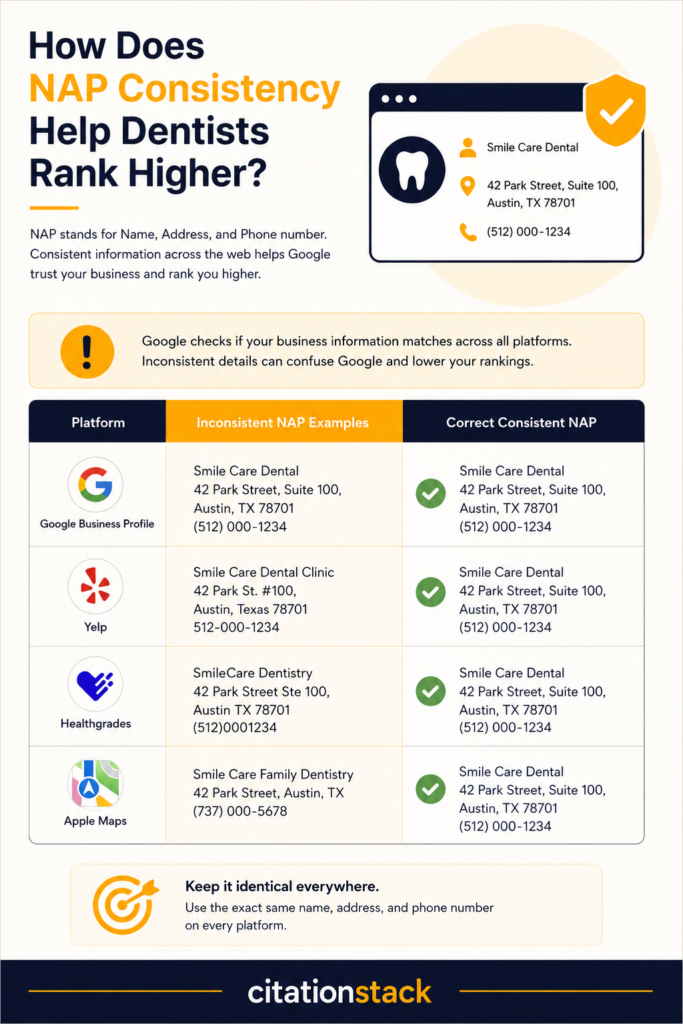
NAP stands for Name, Address, and Phone number. It sounds simple. But NAP consistency, meaning your practice information appearing exactly the same way across every online platform, is one of the most quietly powerful factors in local SEO.
Google does not just look at whether your practice is listed somewhere. It looks at whether the information matches. When it finds conflicting data across different platforms, it gets confused. And a confused Google does not reward you with higher rankings. It plays it safe and pushes your listing down.
What does inconsistency actually look like?
Imagine your practice is listed differently across platforms:
To a human these all look like the same business. But to Google’s algorithm, these are three different signals that do not fully agree with each other. That inconsistency quietly erodes your local ranking potential every single day.
Why does Google care so much about this?
Google is in the business of providing accurate information to users. If it recommends your dental practice and a patient shows up at the wrong address or dials a disconnected number because the listing was outdated, that is a bad experience. Google avoids that by favoring businesses whose information is clean, consistent, and verified across the web.
BrightLocal’s research has repeatedly shown that NAP inconsistency is one of the most common local SEO problems for small businesses, including dental practices. Many dentists do not even realize their information is inconsistent because they never audited their listings after moving offices, changing phone numbers, or rebranding.
Three situations that commonly break NAP consistency for dentists
A practice moves to a new location but only updates Google Business Profile and forgets about 30 other directory listings. The old address keeps circulating online for months or years.
A dentist changes the clinic name slightly, for example from “Dr. Mehta Dental” to “Mehta Family Dentistry,” without updating every existing citation. Now two versions of the name exist across the web and neither one dominates cleanly.
A phone number changes after switching service providers. The new number goes on the website and Google profile, but older directories still show the previous number. Patients call, get no answer, and move on to a competitor.
What should perfect NAP consistency look like?
Pick one exact version of your business name, address format, and phone number. Write it down. Then use that exact version everywhere, every single time, with no variations. Even small differences like “St.” versus “Street” or “Suite 100” versus “#100” matter more than most dentists realize.
How to Build Citations for a Dental Practice Step by Step
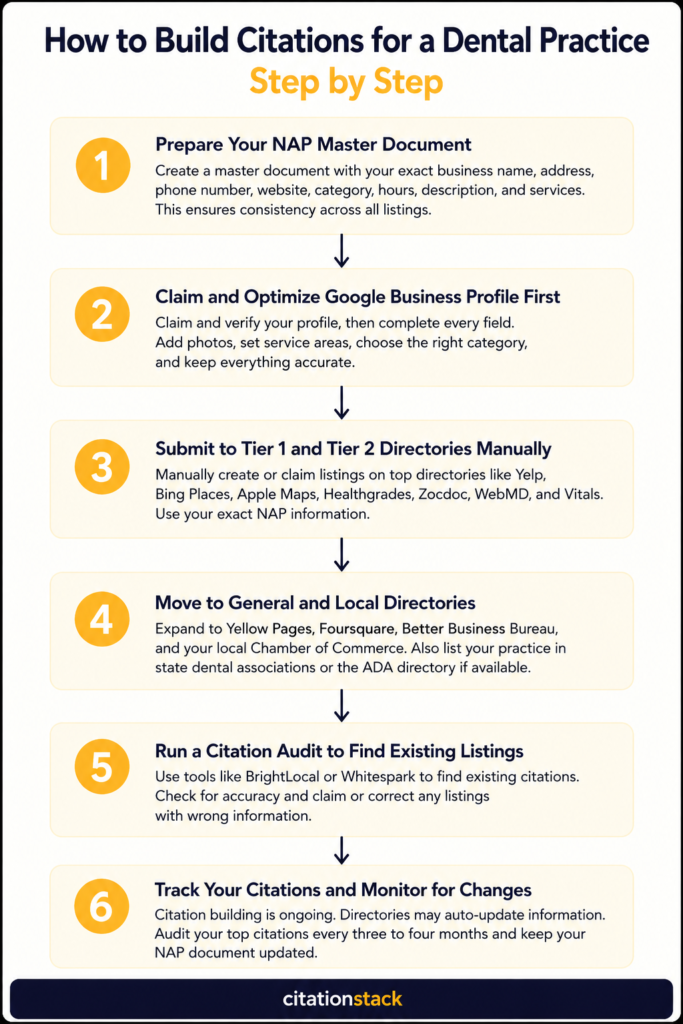
Knowing that citations matter is one thing. Actually building them correctly is where most dental practices either get it right and see results, or get it wrong and wonder why nothing is moving.
This section walks you through the entire citation building process in a clear, practical sequence. Follow these steps in order and you will avoid the most common mistakes from the start.
Step 1: Prepare Your NAP Master Document
Before you submit your practice to a single directory, create a master document with your exact business information. This is your single source of truth.
Include your exact business name, full address with suite number if applicable, local phone number, website URL, business category (use “Dentist” or your specific specialty like “Orthodontist” or “Pediatric Dentist”), business hours, a short business description of around 150 to 200 words, and your top services.
Having this ready before you start means every listing you create will be identical. This eliminates inconsistency from day one rather than trying to fix it later.
Step 2: Claim and Optimize Google Business Profile First
Google Business Profile is not just another directory. It is the foundation everything else builds on. Claim your profile if you have not already, verify it through Google’s process, and fill out every single field completely.
Add real photos of your clinic, waiting area, and team. Set your service areas. Choose the most accurate primary category. A fully optimized Google Business Profile also gives Google a reference point to compare all your other citations against.
Step 3: Submit to Tier 1 and Tier 2 Directories Manually
Start with the highest authority platforms. Go to Yelp, Bing Places, Apple Maps, Healthgrades, Zocdoc, WebMD, and Vitals one by one. Create or claim your listing on each platform using the exact NAP information from your master document.
Manual submission takes more time but gives you full control over the information. For a dental practice, where patient trust is everything, accuracy matters more than speed.
Step 4: Move to General and Local Directories
Once your top-tier listings are live and accurate, expand to Yellow Pages, Foursquare, Better Business Bureau, and your local Chamber of Commerce. Also check if your state dental association or the ADA has a member directory you can be listed in.
These listings add citation volume and reinforce the signals you have already built on the higher-authority platforms.
Step 5: Run a Citation Audit to Find Existing Listings
Many dental practices already have citations they never created themselves. Data aggregators like Data Axle and Neustar Localeze automatically pull business information from public records and distribute it across dozens of directories. This means your practice may already be listed somewhere with outdated or incorrect information.
Use a tool like BrightLocal or Whitespark to run a citation audit. Find every existing listing, check it for accuracy, and claim or correct any that have wrong information. Fixing bad existing citations is just as important as building new correct ones.
Step 6: Track Your Citations and Monitor for Changes
Citation building is not a one-time task. Directories sometimes auto-update information from other sources, which can reintroduce old addresses or phone numbers. Set a reminder to audit your top citations every three to four months.
Keep your master NAP document updated whenever anything changes about your practice, and treat it as a living reference that drives all your online information.
Visual Suggestion: A numbered flowchart showing the six steps from NAP document preparation to ongoing monitoring would work excellently here as a visual summary for readers who want a quick overview.
What Mistakes Do Dentists Make With Local Citations?
Most dental practices that struggle with local SEO are not making big, obvious errors. They are making small, consistent mistakes that quietly add up over time and hold their rankings back. Knowing these mistakes in advance puts you in a much stronger position than most of your local competitors.
Using Inconsistent Business Name Variations
This is the single most common mistake. A dentist might officially register as “Bright Smile Dental Care” but list on some directories as “Bright Smile Dental,” on others as “Bright Smile Dentistry,” and on a few older sites simply as “Dr. Patel Dental Clinic.”
Each variation fragments your citation signal. Google cannot confidently consolidate these into one authoritative entity, and your ranking potential gets divided across multiple incomplete identities.
Pick one exact name and use it everywhere. If your signage says one thing and your Google profile says another, fix that first.
Choosing the Wrong Business Category
Many dentists select a generic category like “Health and Medical” or “Doctor” instead of the more specific “Dentist” or their actual specialty. Category relevance is a strong local ranking signal. If you are an orthodontist, selecting “Orthodontist” as your primary category on every platform will outperform a generic medical category every time for patients searching specifically for orthodontic services.
Ignoring Duplicate Listings
Duplicate listings are more common than most dentists realize. A practice may have two or three Yelp listings created at different times, or multiple Google profiles from before a previous owner claimed the account. Duplicates split your review equity, confuse patients, and send conflicting signals to Google. Finding and merging or removing duplicates is a critical cleanup step that many practices skip entirely.
Building Citations on Low-Quality or Spammy Directories
Some SEO services offer to submit your practice to hundreds of directories for a low flat fee. The problem is that many of those directories have no real authority and some are flagged as spam by Google. A citation on a low-quality directory does not just fail to help you. In some cases it can actively associate your practice with untrusted web properties. Quality always beats quantity in citation building.
Not Completing the Full Business Profile
Getting listed is only half the job. Many dentists claim a directory profile, add their NAP information, and leave everything else blank. No photos, no business description, no services listed, no hours. Incomplete profiles rank lower within the directories themselves, which means less direct patient traffic, and they also send weaker signals to Google compared to fully built out profiles.
Forgetting to Update Citations After Any Business Change
Moving to a new office location, changing your phone number, adding a second location, or even slightly rebranding your practice name all require a full citation update across every platform. Most dentists update their website and Google profile and stop there. The remaining thirty or forty directory listings quietly continue showing outdated information, creating NAP inconsistency that chips away at rankings for months.
Neglecting Healthcare-Specific Directories
Some dental practices focus entirely on general business directories and completely skip platforms like Healthgrades, Vitals, and Zocdoc. For a healthcare provider, these platforms carry extra topical authority. Skipping them means missing both a strong citation signal and a direct channel through which patients actively search for and book dental appointments.
Conclusion
Local citations are not a complicated concept. But they are one of those foundational SEO elements that quietly determine whether your dental practice shows up when a patient needs you, or whether a competitor down the street gets that appointment instead.
What you have learned in this guide is not theory. It is a practical, actionable framework that works specifically for dental practices. Start with a clean NAP master document. Build your presence on the right directories in the right order. Fix inconsistencies before they compound. Avoid the common mistakes that most local dental practices never even realize they are making.
The dentists who dominate Google’s local pack in any city are not always the most experienced or the most affordable. They are often simply the ones who took their online presence seriously when others did not.
Citation building does not require a big budget. It requires consistency, attention to detail, and a willingness to treat your digital footprint with the same care you give your patients.
One thing worth remembering: every accurate citation you build is a long-term asset. Unlike paid ads that stop working the moment you stop paying, a well-built citation profile keeps working for your practice month after month, year after year.
Here is a question worth thinking about: if a potential patient in your city searched for a dentist right now, how many trusted platforms would confirm that your practice is real, active, and worth visiting?
FAQs
A local citation is any online mention of your dental practice that includes your business name, address, and phone number. This can be a full directory listing on platforms like Yelp or Healthgrades, or even a simple mention on a local news website. Citations help Google verify that your practice is real and trustworthy.
There is no fixed magic number. What matters more than quantity is quality and consistency. A dental practice with 50 accurate, high-authority citations will almost always outperform one with 200 inconsistent or low-quality listings. Focus on the right platforms first, then gradually expand your citation volume over time.
Citation building is not an overnight fix. Most dental practices start seeing measurable improvement in local rankings within 60 to 90 days of building and cleaning up citations consistently. Google needs time to crawl, index, and process the new trust signals across multiple platforms.
Yes, absolutely. Google Business Profile is your foundation, but it works best when it is supported by consistent citations across other trusted platforms. Think of your Google profile as the center of a wheel and your citations as the spokes. Without the spokes, the wheel does not hold.