You worked hard to get your business listed across the web. Yelp, Yellow Pages, Bing Places, Apple Maps — you submitted your details everywhere you could find.
But here’s something most local business owners never check: what if your business is listed twice on the same platform? Or worse — listed with slightly different names, addresses, or phone numbers across dozens of directories?
That’s the duplicate citation problem. And it’s more damaging than most people realize.
In this guide, you’ll learn exactly what duplicate citations are, why they confuse Google, how they silently drag down your local rankings, and — most importantly — how to find and fix them before they do serious damage.
What Are Duplicate Citations in Local SEO?
A duplicate citation is when your business appears more than once on the same directory or data platform, often with the same or slightly varied information.
For example, your business “Green Leaf Cafe” might appear twice on Yelp — one listing showing your old address from 2021, and another showing your current one. To a human, it’s obvious these are the same business. But to Google’s crawlers and local ranking algorithms, these are two separate, conflicting signals.
A citation, in local SEO terms, is any online mention of your business’s NAP — Name, Address, and Phone Number. Citations are one of the core ranking factors for local search. The more consistent and authoritative your citations are across the web, the more Google trusts your business and ranks it higher in local results.
Duplicate citations break that trust signal. They introduce confusion, inconsistency, and noise into a system that rewards clarity and accuracy.
Think of it this way. Imagine you ask three different people for directions to the same restaurant. One says it’s on Main Street, another says Oak Avenue, and the third gives you a phone number that goes to voicemail. You’d lose confidence in that restaurant pretty fast. Google reacts the same way to duplicate and inconsistent citations.
How Do Duplicate Citations Actually Hurt Your Local Rankings?
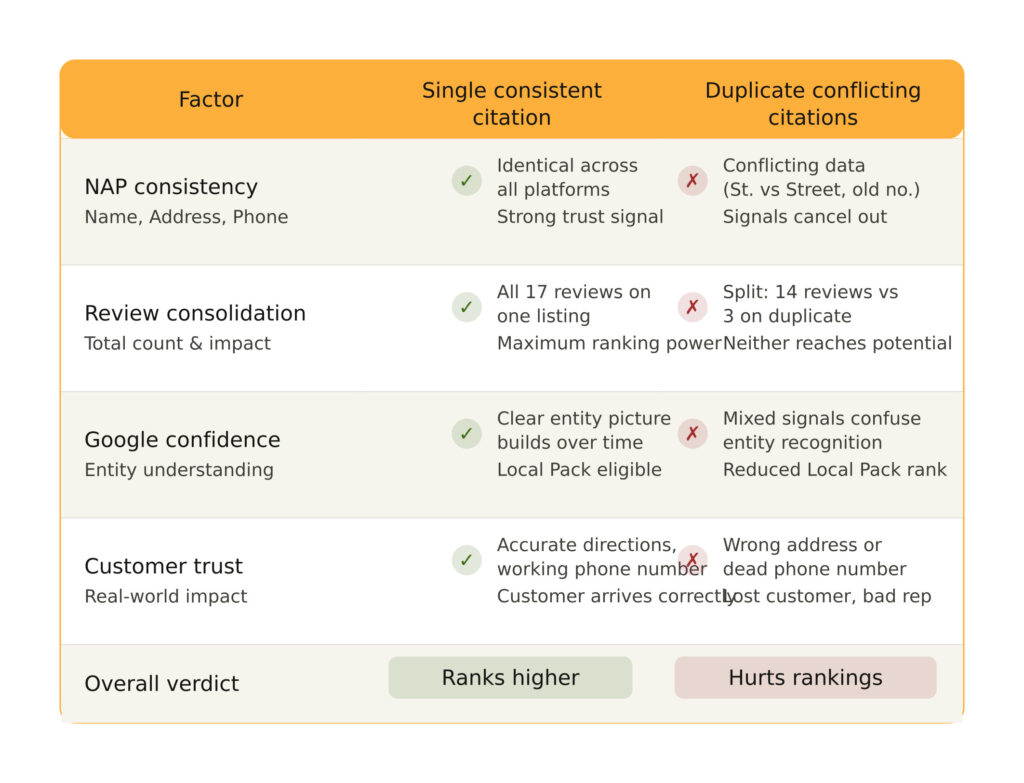
Duplicate citations don’t just sit harmlessly in the background. They actively work against your local SEO efforts in several concrete ways.
They dilute your NAP authority
Google builds trust in your business by seeing the same Name, Address, and Phone Number repeated consistently across hundreds of websites.
Every time it sees matching NAP data, that’s a positive trust signal. But when duplicates exist with even slightly different information, those signals start contradicting each other. Instead of reinforcing your authority, they cancel each other out.
Even small differences matter. “St.” vs “Street”, a missing suite number, or a old phone number on a duplicate listing — these are enough to create inconsistency in Google’s eyes.
They split your ranking power
When two listings for the same business exist on a platform, any reviews, check-ins, or engagement data gets split between them. One listing might have 14 reviews while the duplicate has 3. Neither listing reaches its full potential. A single consolidated listing with 17 reviews would perform significantly better in local rankings.
They confuse Google’s entity understanding
Google uses something called entity-based search to understand businesses. It tries to build a clear picture of who you are, where you are, and what you do. Duplicate citations with conflicting data send mixed signals about your business entity. This makes Google less confident about ranking you, especially in the Local Pack — the top three map results that capture the majority of local search clicks.
They damage customer trust too
This isn’t just a rankings problem. Real customers searching for your business might find the duplicate listing with your old address and show up at the wrong location. Or they might call a disconnected phone number. That’s a lost customer and a damaged reputation, regardless of where you rank.
Related Post: 10 Local Link Building Strategies That Actually Work
What Causes Duplicate Citations in the First Place?
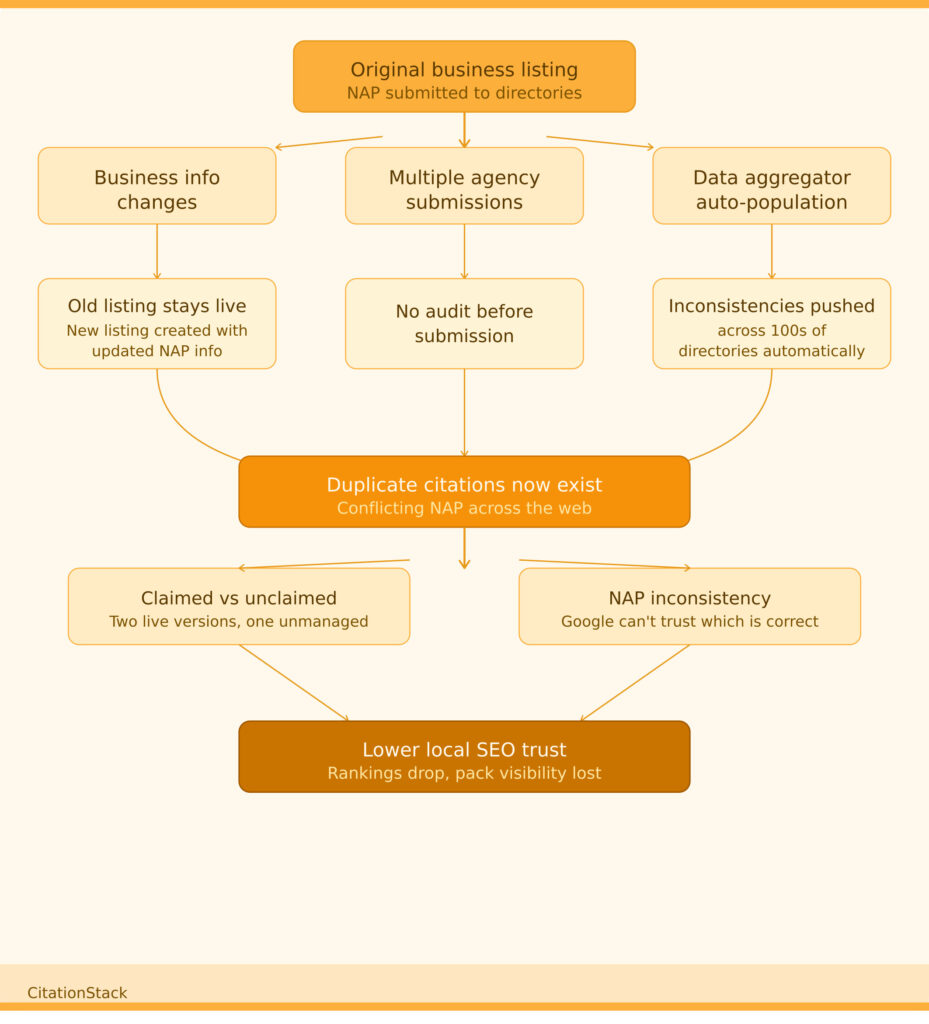
Duplicate citations rarely happen because of one single mistake. In most cases, they build up slowly over time through a combination of factors that are easy to overlook.
Business information changes
This is the most common cause. When a business moves to a new address, changes its phone number, or even rebrands its name, the old listings don’t automatically disappear. They stay live on directories while new listings get created with the updated information. Now you have two versions of your business floating across the web, and neither one tells the complete, accurate story.
Multiple submissions over time
A business owner submits to Yelp in 2019. Then a marketing agency submits to the same directories in 2021 without checking what already exists. Then a second agency does the same in 2023. Each submission layer adds potential duplicates. This is extremely common when businesses switch between SEO providers without proper handover documentation.
Data aggregators and auto-population
Much of the internet’s business directory data comes from a handful of data aggregators like Data Axle, Neustar Localeze, and Foursquare. These aggregators push your business information to hundreds of smaller directories automatically. If your information was ever submitted with inconsistencies, those inconsistencies get multiplied across the entire network. You could have duplicates on sites you never even visited.
Claimed and unclaimed listings
Sometimes a directory creates a listing for your business automatically based on aggregator data. If you later go and manually create a new listing without realizing one already exists, you now have two. One is claimed, one is not, and both are live.
Third-party listing tools without deduplication
Some citation building tools and services submit to directories in bulk without first checking for existing listings. This is a speed-over-quality approach that creates duplicate problems down the line. Always ask any citation service whether they audit for existing listings before submitting new ones.
How to Find Duplicate Citations on Your Business Listings?
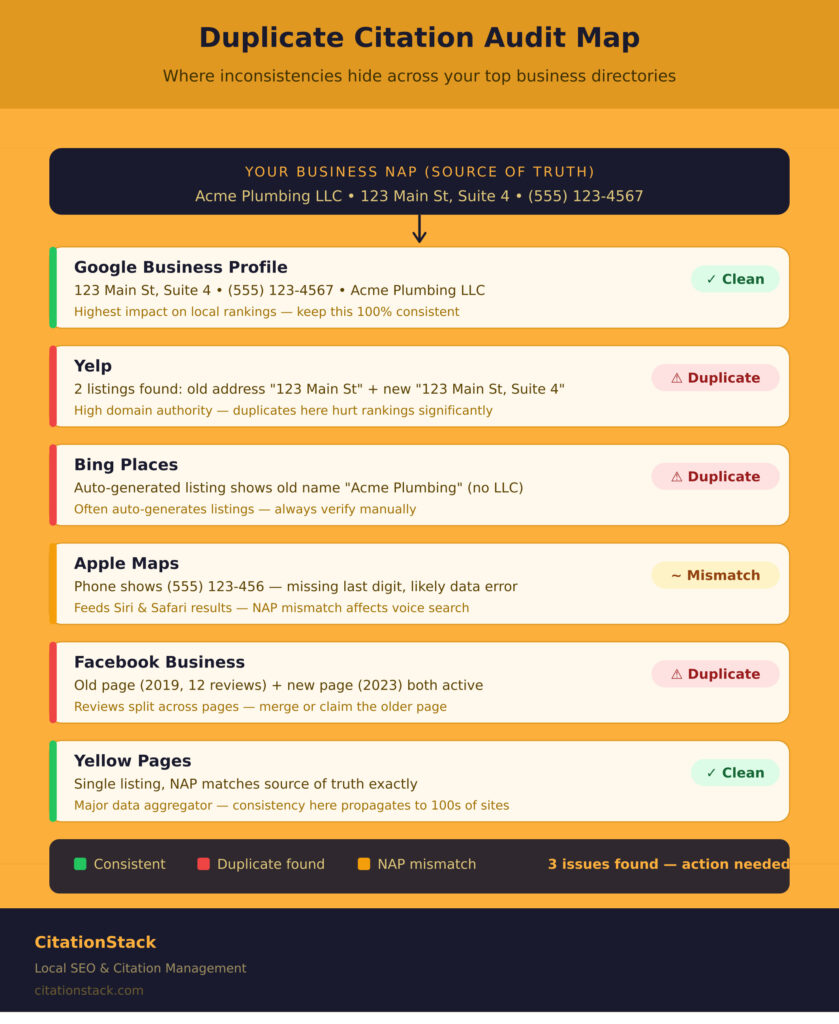
Finding duplicate citations requires a mix of manual searching and tool-assisted auditing. The good news is that even a basic audit can uncover the most damaging duplicates quickly.
Start with a manual Google search
The simplest first step is searching Google directly. Try these search variations one by one:
- “Your Business Name” + “Your City”
- “Your Business Name” + “Your Phone Number”
- “Your Old Business Name” (if you ever rebranded)
- “Your Old Address” + “Your Business Name”
Go through the first two or three pages of results and note every directory where your business appears. Look specifically for listings that show outdated information or appear more than once on the same platform.
Search inside major directories manually
Some platforms are more prone to duplicates than others. Check these manually by searching your business name inside each platform’s own search bar:
| Directory | Why It Matters |
| Google Business Profile | Highest impact on local rankings |
| Yelp | High domain authority, widely crawled |
| Bing Places | Often auto-generates duplicate listings |
| Apple Maps | Feeds Siri and Safari local results |
| Facebook Business | Frequently has old and new pages coexisting |
| Yellow Pages | Major data aggregator partner |
Use citation audit tools
Manual searching only goes so far. Professional tools can scan hundreds of directories at once and flag inconsistencies and duplicates automatically. Some reliable options include BrightLocal, Whitespark, and Moz Local. Most offer a free or trial-level audit that gives you enough data to identify your biggest problems.
When using any audit tool, make sure you run the search using both your current NAP data and any older versions of your business name, address, or phone number. Duplicates often hide under old information that tools miss if you only search current data.
Look for these warning signs in your audit results
- Same directory appearing twice in your citation list
- Listings with a mix of old and new phone numbers
- Address variations like “Suite 4” vs “#4” vs no suite number at all
- Business name variations like “LLC” included in some, missing in others
- Listings with zero reviews sitting alongside your main active listing
How to Fix Duplicate Citations Step by Step
Finding duplicates is only half the job. The real work is cleaning them up properly. Rushing this process or doing it incorrectly can sometimes make things worse, so follow this workflow carefully.
Step 1: Build a master NAP document first
Before you touch a single listing, decide what your correct NAP looks like. Write it down in one document and use it as your reference for every step that follows.
Your master NAP should include your exact business name (decide once whether you include “LLC”, “Inc”, or not), your full current address with suite or unit number formatted consistently, your primary phone number, your website URL, and your business hours. Every listing you fix or create from this point forward must match this document exactly.
Step 2: Claim all unclaimed listings
You cannot edit or delete a listing you do not own. Go through every directory where you found duplicates and claim each listing under your business account. Most platforms like Google, Yelp, and Bing have a verification process that involves a phone call, postcard, or email confirmation.
Even listings you plan to delete should be claimed first. An unclaimed listing can sometimes be re-created by data aggregators after you delete it, creating the same problem again.
Step 3: Decide what to do with each duplicate
Not every duplicate gets treated the same way. Here is how to approach each situation:
| Situation | Best Action |
| Duplicate on same platform, both unclaimed | Claim the better one, request removal of the other |
| Duplicate with old address or phone | Update the correct one, suppress or delete the old one |
| Duplicate created by aggregator | Update at aggregator source level first |
| Two listings with split reviews | Merge if the platform allows it (Google allows merges) |
| Old listing under previous business name | Claim and update or report as closed |
Step 4: Delete or suppress duplicates
Each directory handles removal differently. On Google Business Profile, you can report a duplicate listing directly through the platform and request a merge. On Yelp, you can contact support to close a duplicate. On Bing Places, you can claim and then mark the old listing as closed.
For directories where you cannot get direct access, suppression is your next best option. Suppression means updating the duplicate with enough incorrect or minimal information that it stops being an active signal. This is a last resort and not as clean as full removal.
Step 5: Fix the root cause at the aggregator level
If your duplicates came from data aggregators, fixing individual directory listings is not enough on its own. You need to correct your information at the aggregator source.
The three main aggregators that feed most US directories are Data Axle, Neustar Localeze, and Foursquare. Submitting your corrected NAP to these aggregators ensures that new directories pulling data from them get the right information, rather than recreating old duplicates over time.
Step 6: Monitor and verify over 60 to 90 days
Citation cleanup is not instant. After making corrections, check back across your directories every few weeks for 60 to 90 days. Some platforms take time to update. Some aggregator-fed directories will refresh on their own cycle.
Set a reminder to re-run your citation audit after 90 days to confirm that all corrections held and no new duplicates appeared.
What Happens If You Ignore Duplicate Citations?
Some business owners find out about duplicate citations and decide to deal with them later. Later turns into never, and the problem quietly compounds in the background. Here is exactly what happens when duplicate citations go unaddressed.
Your local pack rankings plateau or decline
The Google Local Pack, those three business listings that appear at the top of local search results with a map, is where the majority of local search clicks go. Ranking in the Local Pack depends heavily on citation consistency and authority. When Google sees conflicting NAP data across your citations, its confidence in your business listing drops. That drop in confidence directly translates to lower ranking positions or complete absence from the Local Pack for competitive keywords.
What makes this frustrating is that the damage is invisible. You will not get a penalty notification. You will not see a warning in Google Search Console. Your rankings will simply stop climbing or start slipping, and without a citation audit, you will have no idea why.
Your competitors pull ahead without doing anything special
Local SEO is a relative game. You do not need to make a mistake for a competitor to outrank you. If a competitor simply has cleaner, more consistent citations than you do, they will rank above you even if their website is weaker or their Google Business Profile is less optimized. Ignoring duplicate citations means handing your competitors an advantage they did not have to earn.
Customer experience suffers directly
This is the part that costs real money. A potential customer searches for your business, finds the duplicate listing with your old address, drives to that location, and finds nothing there. That customer does not come back. They may leave a negative review about the wrong address. They will almost certainly choose a competitor next time.
The same thing happens with phone numbers. An old disconnected number on a duplicate listing means lost calls, lost bookings, and lost revenue that you never even know about.
Review equity gets permanently diluted
Every review left on a duplicate listing is a review that could have strengthened your primary listing. A business with 40 reviews on one listing ranks significantly better than a business with 25 reviews on one listing and 15 on a duplicate. Those 15 reviews on the duplicate are essentially wasted social proof. Once reviews accumulate on a duplicate, recovering that review equity is difficult and sometimes impossible if the platform does not support merging.
The problem gets harder to fix over time
Duplicate citations do not stay static. Data aggregators continue to push information across the web on a regular cycle. A duplicate that exists today will be replicated across more directories over time. The longer you wait, the more directories carry the bad data, and the more cleanup work you face later.
Fixing 3 duplicates today takes a fraction of the time and effort of fixing 30 duplicates six months from now.
Pro Tips to Prevent Duplicate Citations From Coming Back
Pro Tips:
- Create a NAP style guide and share it with everyone
- Always audit before you submit, never after
- Control your data at the aggregator level
- Set a quarterly citation audit schedule
- Be especially careful during business transitions
- Use a citation management tool for ongoing monitoring
Fixing duplicates is important. But if you do not put systems in place after the cleanup, the same problem will reappear within months. These tips are what separates businesses that maintain strong local rankings long term from those that are stuck in a constant cycle of fixing the same issues.
Create a NAP style guide and share it with everyone
The single most effective prevention tool costs nothing. Write down your exact business name, address, phone number, and website URL in a simple document and share it with every person or agency that ever touches your online presence. This includes your web developer, your social media manager, any SEO agency you hire, and anyone who handles directory submissions.
The most common source of new duplicates is a new team member or agency submitting listings without knowing what the approved NAP format looks like. A one-page NAP style guide eliminates this problem entirely.
Always audit before you submit, never after
Before submitting your business to any new directory, search that directory first to check if a listing already exists. This takes two minutes and prevents the most avoidable type of duplicate. Make this a non-negotiable rule for anyone working on your local SEO.
Control your data at the aggregator level
The most leveraged thing you can do for long-term citation health is maintain accurate data with the major aggregators. When your aggregator data is clean and consistent, the hundreds of downstream directories that pull from those aggregators stay clean too. This one upstream fix prevents dozens of downstream problems.
Set a quarterly citation audit schedule
Citation data changes on its own even when you do nothing. Aggregators update, directories auto-populate, and new platforms launch that scrape existing data. A quarterly audit of your top 20 to 30 directories takes about an hour and catches problems before they compound.
Here is a simple quarterly checklist to follow:
- Verify your Google Business Profile NAP matches your master document
- Check Yelp, Bing Places, Apple Maps, and Facebook for any changes
- Run a quick name search on your top three directories to check for new duplicates
- Confirm your aggregator data is still accurate at Data Axle and Neustar Localeze
- Check if any new reviews appeared on listings other than your primary one
Be especially careful during business transitions
The highest-risk moments for duplicate creation are business moves, phone number changes, rebrands, and ownership transfers. Every one of these events creates an opportunity for old information to stay live while new information gets added. Whenever a transition happens, run a full citation audit within 30 days and update every listing systematically rather than one at a time as you remember them.
Use a citation management tool for ongoing monitoring
Once your citations are clean, a paid tool like BrightLocal or Whitespark makes maintaining them significantly easier. These tools track your listings continuously and alert you when something changes or a new duplicate appears. For a local business that depends on search visibility, the monthly cost of a monitoring tool is far less than the revenue lost from citation problems going undetected for months.
Conclusion
Duplicate citations are one of those local SEO problems that hide in plain sight. They do not trigger warnings, they do not send you alerts, and they do not announce themselves in any obvious way. They simply work quietly in the background, diluting your ranking signals, confusing Google’s understanding of your business, and sending potential customers to the wrong address.
The good news is that this is entirely fixable. A proper citation audit, a clean master NAP document, and a systematic cleanup process can undo months or even years of accumulated citation damage. And once you have put the right prevention habits in place, maintaining clean citations requires very little ongoing effort.
If you take one thing from this guide, let it be this: citation consistency is not a one-time task. It is an ongoing commitment to making sure every corner of the web tells the same accurate story about your business. The businesses that rank consistently in local search are not always the ones with the most citations. They are the ones with the cleanest ones.
Is your business currently affected by duplicate citations, or have you recently gone through a citation cleanup? Share your experience in the comments below.
Frequently Asked Questions
Not every duplicate causes immediate damage, but all duplicates carry risk. A duplicate with matching NAP data is less harmful than one with conflicting information. However, even matching duplicates split your review equity and create unnecessary confusion for Google’s entity understanding. The safest approach is to clean up all duplicates regardless of whether the information matches.
Most businesses begin to see ranking improvements within 60 to 90 days of completing a citation cleanup. The timeline varies depending on how many duplicates existed, how widely the incorrect data had spread through aggregator networks, and how competitive your local market is. Aggregator-fed directories can take 6 to 8 weeks to refresh after you correct the source data.
You can absolutely handle citation cleanup yourself, especially if you have fewer than 10 to 15 duplicates to address. The process requires patience and attention to detail rather than technical expertise. For businesses with widespread citation problems across dozens of directories, or for agencies managing multiple client listings, a professional citation service saves significant time and ensures nothing is missed.
A duplicate citation means your business appears more than once on the same platform. An inconsistent citation means your NAP data varies between different platforms. Both problems hurt your local SEO, but they require slightly different fixes. Duplicates need to be merged, suppressed, or deleted. Inconsistencies need to be updated to match your master NAP document. Many businesses have both problems at the same time.
Citation cleanup improves one important ranking signal but it is not the only factor Google uses for local rankings. Your Google Business Profile optimization, the quantity and quality of your reviews, your website’s local SEO, and the overall authority of your domain all play a role. Fixing duplicate citations removes a barrier to ranking well, but you will likely need to work on multiple signals together to see significant Local Pack improvement.