Let’s be honest — local SEO is frustrating.
You’ve set up your Google Business Profile. Your business name, address, and phone number are consistent everywhere.
You’re posting regularly, getting a few reviews, and doing everything the “experts” say. But your competitors are still showing up above you on Google Maps and in local search results.
So what’s the missing piece?
Most of the time, it comes down to one thing: local links.
While citations and on-page SEO lay the foundation, local backlinks are what actually push your business to the top of search results in a competitive market.
Google sees every local link as a vote of confidence — a signal that your business is trusted, relevant, and established in your community.
But here’s the problem: most local businesses either ignore link building entirely, or they go about it the wrong way — buying cheap backlinks, submitting to spammy directories, or copying tactics that only work for big national brands.
This guide is different.
In this article, you’ll find 10 local link building strategies that are working right now in 2026 — tested across real local businesses in the US, UK, and Australia.
These aren’t theories pulled from a decade-old SEO blog. These are practical, actionable tactics you can start using this week, whether you’re a small business owner doing your own SEO or a digital marketing agency managing multiple local clients.
Let’s get into it.
10 Best Local Link Building Strategies
1. Get Listed in Local Business Directories (The Right Way)
If you’ve ever Googled “submit business to directories” and ended up on a site promising to list you in 500 directories overnight for $5 — stop right there.
That approach doesn’t just waste your money. It can actually hurt your local SEO.
Here’s what actually works.
What are local business directories?
Local business directories are online platforms where businesses list their name, address, phone number, website, and other details.
Google uses these listings as trust signals. When your business information appears consistently across multiple credible directories, Google becomes more confident that your business is legitimate — and rewards you with better local rankings.
The key word there is credible. Not all directories are created equal.
Which directories actually matter in 2026?
There are three types of directories worth your time:
- The first is general authority directories — platforms like Google Business Profile, Yelp, Bing Places, Apple Maps, and Facebook. These are non-negotiable. Every local business should be listed here, fully filled out, with accurate information.
- The second is niche-specific directories — platforms built around your industry. A plumber should be on Angi (formerly Angie’s List) and HomeAdvisor. A restaurant should be on TripAdvisor and OpenTable. A lawyer should be on Avvo and FindLaw. These directories carry strong topical relevance, which matters a lot for local SEO.
- The third is geo-specific directories — local directories tied to your city, county, or region. Think local Chamber of Commerce websites, city business registries, and regional business associations. These are particularly powerful because they signal geographic relevance — exactly what Google looks for in local search.
Why NAP consistency is everything
NAP stands for Name, Address, and Phone Number. Every time your business appears in a directory, these three details need to be identical — not just similar. “St.” versus “Street,” or a missing suite number, can confuse Google’s algorithm and dilute the trust signals you’re trying to build.
This is where a lot of businesses quietly lose ground. They submitted their details to a dozen directories years ago, their address changed, their phone number changed — and now there’s a mess of conflicting information scattered across the web.
Cleaning that up and maintaining consistency is the foundation of everything in local SEO.
Manual submission vs. automated tools
There are tools that promise to push your business information to hundreds of directories automatically. They sound convenient, but the reality is that many of those directories are low-quality, outdated, or outright spammy.
Automated tools also make it harder to customize your listing for each platform — and a fully optimized listing performs significantly better than a basic auto-filled one.
Manual submission takes more time, but the quality of the citations you build is far higher. If you don’t have the time to do it yourself, working with a specialist citation service that handles manual submissions on your behalf is a much better investment than any automation tool.
A quick real-world example
A home services business in Austin, Texas was stuck on page 2 of Google for “emergency plumber Austin” for over a year.
After a thorough citation audit — fixing inconsistent NAP data and adding listings to 12 high-quality local and niche directories — they moved to the top 3 of the local pack within eight weeks. No paid ads. No new content. Just clean, consistent citations.
That’s the power of getting your directory strategy right.
| Category | Low-Quality Directories (Avoid) | High-Authority Directories (Use) | Why It Matters |
| General Directories | Random bulk directories (e.g., “500 listings for $5”), outdated listing farms, spammy link directories | Google Business Profile, Yelp, Bing Places, Apple Maps, Facebook | These platforms have real authority, traffic, and trust signals that directly impact rankings |
| Niche-Specific Directories | Generic directories unrelated to your industry, irrelevant listing sites | Angi, HomeAdvisor, TripAdvisor, OpenTable, Avvo, FindLaw | Industry relevance boosts topical authority and improves keyword-specific rankings |
| Geo-Specific Directories | Fake “local” directories with no real traffic, PBN-style city sites | Local Chamber of Commerce websites, city business directories, regional trade associations | Strong location signals help Google verify your business relevance in a specific area |
| Submission Method | Automated bulk submission tools pushing to hundreds of low-quality sites | Manual submission or professional citation services focusing on quality directories | Manual listings allow optimization, accuracy, and better long-term SEO impact |
| NAP Consistency | Inconsistent listings (different address formats, old phone numbers, duplicates) | Fully consistent Name, Address, Phone Number across all listings | Consistency builds trust signals and prevents ranking dilution |
2. Partner with Local Organizations and Chambers of Commerce
Here is something most local business owners overlook completely.
Your local Chamber of Commerce is not just a networking group for people who enjoy awkward breakfast meetings. It is one of the most reliable sources of high-quality, locally relevant backlinks available to any small business.
And in most cases, all you have to do is become a member.
Why Chamber of Commerce links are so valuable
Chamber of Commerce websites are trusted by Google for one simple reason: they have been around for a long time, they are closely tied to a specific geographic area, and they link only to legitimate, verified local businesses.
That combination of age, local relevance, and editorial selectivity makes their backlinks genuinely powerful for local SEO.
When Google crawls a Chamber of Commerce website and finds a link pointing to your business, it reads that as a strong signal that you are an established, trustworthy part of the local business community. That is exactly the kind of signal that moves the needle in local search rankings.
How to get started
The process is straightforward. Find your local Chamber of Commerce, check their membership options, and join. Most memberships in the US, UK, and Australia range from $150 to $500 per year depending on your city and business size. Once you are a member, your business gets listed in their online member directory, which almost always includes a link to your website.
Before you sign up, do one quick check: visit their website and confirm that their member directory actually contains clickable links to business websites. Most do, but it is worth verifying before you pay.
Go beyond just the Chamber
The Chamber is a great starting point, but there are other local organizations worth exploring as well.
Local business improvement districts (BIDs) often maintain member directories with backlinks. Regional trade associations in your industry frequently have local chapter websites that link to members. Neighborhood business associations, local entrepreneur groups, and even community foundations sometimes offer listing opportunities for businesses that contribute to their mission.
Each of these organizations adds another locally relevant, editorially trusted link pointing back to your site. The cumulative effect on your local rankings is significant.
Do not forget local EDU and GOV pages
Local government websites and university pages occasionally publish lists of approved local vendors, community business partners, or event sponsors. These links carry enormous authority because of the domain type. Keep an eye on local council websites, city economic development pages, and nearby college or university business departments. If there is a legitimate reason for your business to appear on one of those pages, pursue it actively.
A practical tip
When you join any local organization, do not just stop at getting your basic listing live. Reach out to the organization and ask if there are additional opportunities: guest blog posts on their website, interviews for their newsletter, or mentions in their social media. Every additional touchpoint is a potential backlink and a visibility boost.
3. Sponsor Local Events, Charities, or Sports Teams
This is one of the most underrated local link building strategies out there. And the best part? You get a lot more than just a backlink.
When you sponsor a local event, charity, or sports team, you get brand visibility in your community, goodwill from local residents, and in almost every case, a backlink from the event or organization’s website. That is a pretty strong return on a relatively modest investment.
How sponsorships generate backlinks
Most local events, charity organizations, and community sports teams maintain a website or at least a dedicated webpage for their sponsors. When you become a sponsor, your business name and logo get featured on that page, almost always with a link back to your website.
These links are valuable for several reasons. The websites hosting them are typically local, trusted, and editorially managed. They are not directories where anyone can submit their information. They are pages where your link appears because your business made a genuine contribution. Google recognizes that difference.
What types of sponsorships work best for local SEO
Not every sponsorship will produce the same SEO benefit. Here is how to think about it.
Local charity events tend to have well-maintained websites with decent domain authority. A charity 5K run, a food bank fundraiser, or a community arts festival will usually have a sponsors page that lives permanently on their site, meaning your link stays active long after the event is over.
Local sports teams, particularly youth leagues and amateur adult leagues, are another excellent option. A youth soccer league or a local cricket club in the UK will almost always have a website listing their sponsors. These sites may have lower domain authority, but the local relevance is extremely high, which matters specifically for local search rankings.
Community events organized by schools, neighborhood associations, or local government bodies can also produce links from highly trusted domains. A link from a city-organized festival’s website or a school’s fundraising page is genuinely valuable.
How to find sponsorship opportunities
Start by searching Google for terms like “sponsor a local event [your city]”, “[your city] charity sponsorship opportunities”, or “[your city] youth sports sponsors”. You can also check local Facebook community groups, your Chamber of Commerce notice board, and local news websites that cover upcoming events.
Once you find an opportunity, reach out directly. Most organizations are actively looking for sponsors and will respond quickly to a genuine inquiry. Ask specifically whether your sponsorship includes a link on their website, and if possible, request that the link goes to a relevant page on your site rather than just your homepage.
What does it cost
Sponsorship costs vary widely. A small youth sports team might ask for $200 to $500 per season. A local charity event might offer sponsorship tiers starting from $100. A larger community festival might have tiers ranging from $500 to several thousand dollars.
For local link building purposes, the lower tiers are usually sufficient to get your link on their sponsors page. You do not need the premium package to get the SEO benefit.
Think long term
The smartest approach is to build ongoing relationships with local organizations rather than one-off sponsorships. If you sponsor the same charity event year after year, your link gets renewed annually, your brand becomes associated with a trusted community cause, and you build genuine goodwill that generates word-of-mouth referrals alongside the SEO benefit.
That combination of direct business value and SEO value is what makes local sponsorships one of the highest-ROI link building tactics available to local businesses.
Local Sponsorship SEO Strategy: What Works Best
| Sponsorship Type | Estimated Cost Range | Expected SEO Benefit | Why It Works |
| Charity Events (5K runs, fundraisers, food drives) | $100 – $1,000+ | High | These sites are usually well-maintained, have decent authority, and keep sponsor pages live long-term, giving you lasting backlinks |
| Local Sports Teams (youth leagues, amateur clubs) | $200 – $500 per season | Medium–High | Strong local relevance signals; even if authority is lower, Google values geo-specific trust for local rankings |
| Community Festivals & Events (school events, city festivals, local fairs) | $500 – $5,000+ | Very High | Often backed by schools or government bodies, leading to highly trusted backlinks (sometimes even .edu or .gov domains) |
4. Get Featured in Local News and Online Publications
If you want a backlink that your competitors genuinely cannot replicate overnight, this is it.
A link from a local newspaper website, a regional online publication, or a city-focused blog carries a level of authority and trust that no directory submission can match. These are editorially earned links. Google treats them very differently from links you build yourself, and that difference shows up directly in your rankings.
Why local press links hit differently
Local news websites have been building their domain authority for years, sometimes decades. They publish consistently, they are indexed regularly by Google, and they are trusted sources of information for their geographic area. A backlink from a local newspaper website is essentially a public endorsement from one of the most credible voices in your community.
Beyond the SEO value, press features drive real referral traffic. People who read the local news and see your business mentioned are far more likely to become customers than someone who found you through a random directory listing.
How to get your business featured
The most common reason local businesses do not get press coverage is simple: they never ask.
Local journalists and editors are constantly looking for interesting stories, expert opinions, and community voices. Your job is to make it easy for them to say yes.
Here are a few approaches that work well.
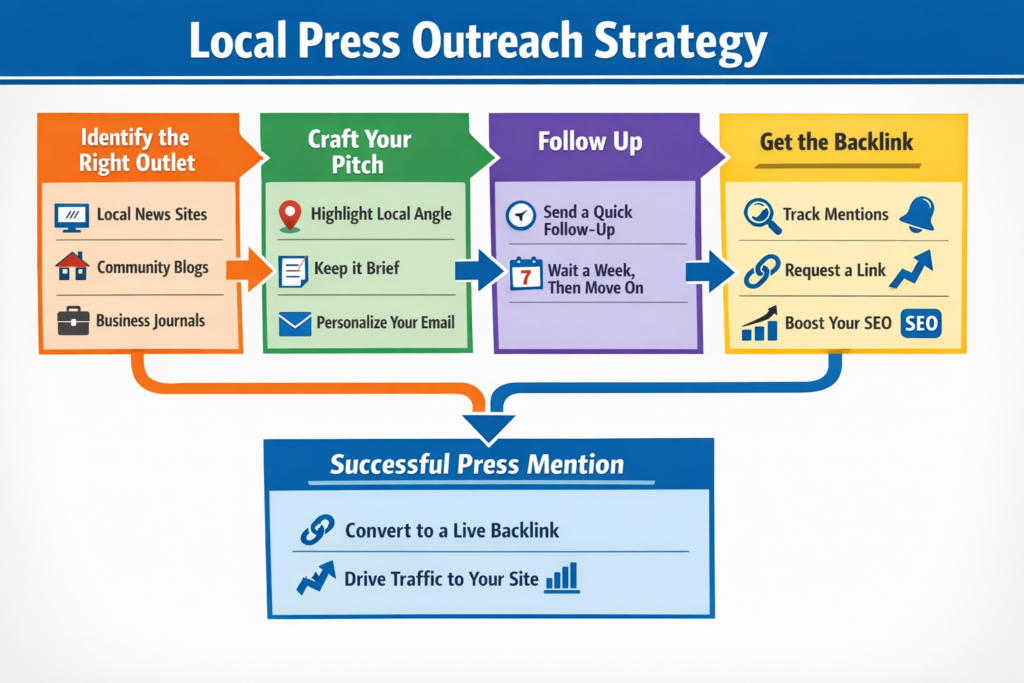
The first is the expert angle. Identify topics in your industry that are relevant to your local community right now. If you are a pest control company, offer to comment on seasonal pest trends in your city. If you run an accounting firm, offer tips on local tax changes affecting small businesses. Reach out to local journalists with a short, specific pitch positioning yourself as a local expert. Keep your email to three or four sentences. Journalists get a lot of emails, and brevity gets responses.
The second approach is the story angle. Is there something genuinely interesting happening at your business? A significant milestone, a community initiative, a unique service you are launching, or a local hiring push? Local news outlets love stories that connect business activity to community impact. Frame your pitch around the community benefit, not just your business.
The third approach is responding to journalist requests. Platforms like Qwoted, Featured.com, and Help a Reporter Out (HARO) connect journalists with expert sources. Many local journalists use these platforms. Set up a free account, monitor requests in your industry, and respond quickly with a useful, specific quote. If your response gets used in an article, you will almost always receive a backlink.
Target the right publications
Do not limit yourself to just the main local newspaper. Think about the full landscape of local online publications in your area.
City and neighborhood blogs often have strong local followings and decent domain authority. Regional lifestyle magazines frequently publish business profiles and expert round-ups. Local business journals cover industry news and company milestones. Community news websites focused on specific neighborhoods or districts are also worth approaching, particularly if your business serves a specific part of the city.
A simple outreach template that works
When reaching out to a local journalist or editor, keep it short and make it about them, not you. Something like:
“Hi [Name], I noticed you cover local business news in [City]. I run [Business Type] here and I would love to offer some perspective on [Specific Local Topic] if it would be useful for a future piece. Happy to chat by phone or email at your convenience.”
That is it. No lengthy press releases. No attachments. Just a clear, relevant, low-friction offer.
Follow up once if you do not hear back within a week. If there is still no response, move on and try again next month with a different angle.
Track your mentions
Set up a free Google Alert for your business name so you are notified any time someone writes about you online. Occasionally a publication will mention your business without linking to your website. When that happens, reach out politely and ask if they would be willing to add a link. Most journalists and editors are happy to do this, and it costs you nothing but a brief email.
5. Build Relationships with Complementary Local Businesses
Here is a link building strategy that feels less like SEO and more like good business sense. And honestly, that is exactly why it works so well.
Partnering with complementary local businesses for backlinks is one of the most natural, sustainable, and Google-friendly approaches to local link building. When done correctly, it benefits both businesses, serves the customer, and produces links that look completely organic because they genuinely are.
What does complementary mean here
A complementary business is one that serves the same target customer as you but does not compete with you directly.
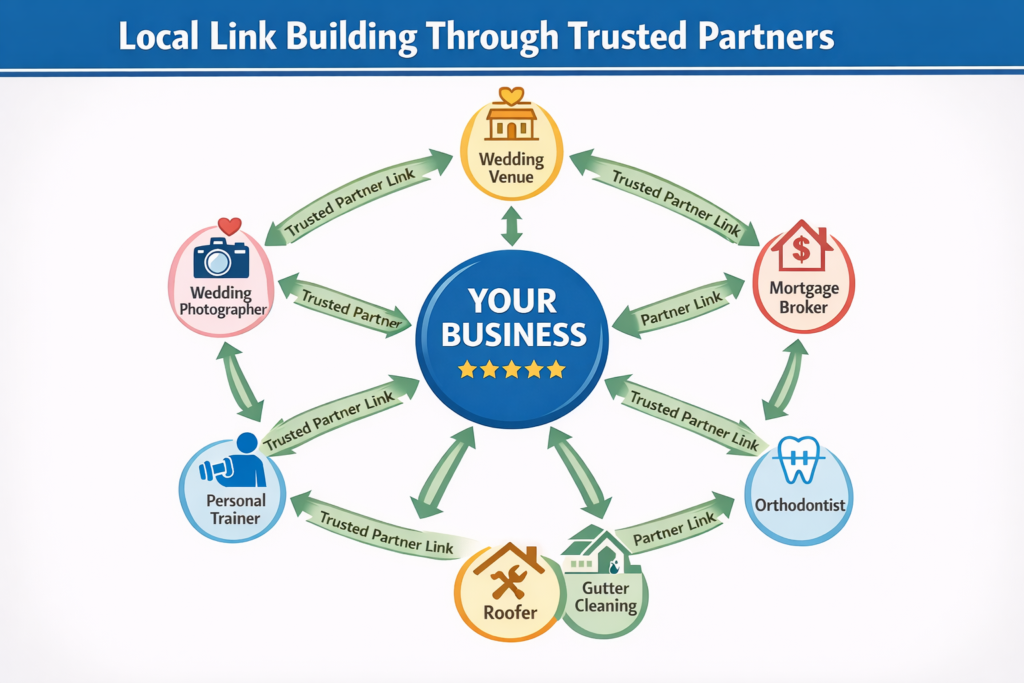
A few examples to make this concrete. A wedding photographer and a wedding venue. A personal trainer and a nutritionist. A real estate agent and a mortgage broker. A roofing company and a gutter cleaning service. A dentist and an orthodontist.
These businesses share an audience. Their customers often need both services around the same time. It makes complete sense for them to reference each other, and that natural relevance is exactly what makes the backlinks valuable from Google’s perspective.
How to approach this the right way
The key to making this work is to lead with value rather than immediately asking for a link. Start by identifying five to ten complementary businesses in your area that have a decent website and an active online presence.
Before reaching out, do something genuinely useful for them first. Share one of their social media posts. Leave them a thoughtful Google review. Refer a customer their way if the opportunity arises naturally. Building a small amount of goodwill before making any kind of ask dramatically increases your response rate.
When you do reach out, keep the conversation focused on mutual benefit. Something like: “I have been referring customers your way for a while now and thought it might make sense to make that relationship more official. Would you be open to featuring each other on our websites as recommended partners?”
Most business owners respond positively to this kind of approach because it is framed around helping their customers, not around SEO.
Where to place these links on your website
Create a dedicated page on your website called something like “Trusted Local Partners” or “Recommended Services.” List your partner businesses there with a brief description and a link to their website. Ask them to do the same for you on their site.
This kind of page serves a genuine purpose for your visitors. It helps them find related services they might need, which improves their experience on your site. And from an SEO perspective, it creates a naturally occurring local link that sits within relevant, contextual content rather than a footer widget or a generic links page.
What about reciprocal links
You might have heard that reciprocal links, where two websites link to each other, are risky or ineffective. The reality is more nuanced than that.
Reciprocal links become a problem when they are part of a link exchange scheme, when they are unrelated to both businesses, or when they exist purely for SEO with no genuine connection between the businesses involved. Google is good at identifying that kind of manipulation.
But when two genuinely complementary local businesses link to each other because it makes sense for their customers, that is completely natural. Google is not penalizing businesses for having reasonable, relevant cross-references with local partners. The intent and the context are what matter.
Scale this approach gradually
Do not try to sign up twenty partner businesses in a week. Build these relationships one at a time, focus on quality over quantity, and make sure every partnership you establish reflects a genuine connection that would make sense to a customer reading your website.
Five strong, relevant local partner links from well-maintained local business websites will outperform fifty links from unrelated, low-quality sources every single time.
Also Read: What is NAP in Local SEO and Why does it matter?
6. Create Locally Relevant Content That Earns Links Naturally
Every strategy we have covered so far involves reaching out to someone and asking for a link in some form. This one is different.
This strategy is about creating content so useful and so locally specific that other websites want to link to it without you ever having to ask. In the SEO world, this is called earning links. And when it works, it keeps working for months and years after you publish.
Why locally relevant content attracts links
Generic content does not get linked to. Nobody is going to link to your “What is SEO” blog post when there are already ten thousand versions of that article online.
But locally specific content? That is a different story.
When you publish something that is genuinely useful to people in your city or region, and that does not exist anywhere else on the web, local bloggers, journalists, community websites, and even local government pages will reference it. They link to it because it serves their audience. That is the most natural, most sustainable form of link building there is.
What types of local content earn links
Here are the content formats that consistently attract local backlinks:
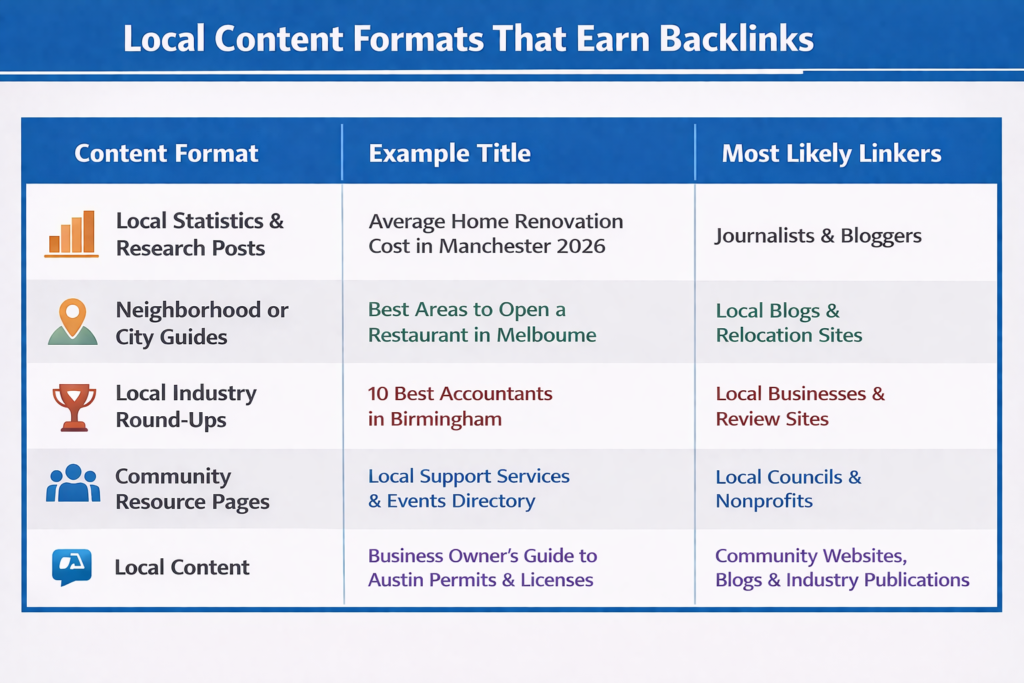
- Local statistics or research posts: “Average Home Renovation Cost in Manchester 2026” or “How Many Small Businesses Are in Austin?” Original data and locally compiled statistics get cited by journalists, bloggers, and industry publications regularly.
- Neighborhood or city guides: “Best Areas to Open a Restaurant in Melbourne” or “A Business Owner’s Guide to [Your City] Permits and Licenses.” These attract links from local blogs, relocation websites, and community resources.
- Local industry round-ups: “10 Best Accountants in Birmingham” or “Top Rated Plumbers in Brisbane.” These pages attract links from the businesses mentioned and from anyone searching for trusted recommendations.
- Community resource pages: A genuinely helpful page listing local support services, community events, or industry resources in your area. Local councils and nonprofits love linking to well-organized resource pages.
A real example of this working
A local moving company in Chicago published a detailed guide called “Moving to Chicago: Neighborhood by Neighborhood Cost Breakdown.” The guide included average rental prices, lifestyle notes, commute times, and practical tips for each major neighborhood. Within four months, it had earned backlinks from three local real estate blogs, a Chicago lifestyle magazine, and a relocation service website. None of those links were asked for. They came naturally because the content was genuinely useful and did not exist anywhere else.
That single piece of content still drives referral traffic and ranking authority today.
How to find content ideas that will earn local links
The fastest way is to look at what is already being linked to in your area. Search for your city name plus your industry on Google and look at the top results. What kind of content are they publishing? What gaps do you notice?
You can also use a simple tool like Ubersuggest or Google Search Console to find locally relevant questions people are already searching for. Questions that start with “best,” “how much,” “where to find,” or “guide to” in your city are all strong content opportunities.
Promotion is still part of the process
Even great local content needs a small push to get its first few links. Once you publish, share the piece directly with a handful of local bloggers or journalists who cover related topics. Do not ask for a link outright. Just let them know the resource exists and mention that their audience might find it useful. That gentle nudge is often enough to get the ball rolling.
Related Post: What are Local Citations in SEO?
7. Claim Unlinked Brand Mentions
This is genuinely one of the easiest wins in all of local link building. And most businesses have no idea it exists.
Here is the situation. Someone has already written about your business online. Maybe a local blogger reviewed your service. Maybe a community website mentioned you in a round-up. Maybe a local news piece referenced your business name in passing. The content is live, the mention is positive, but there is no link pointing back to your website.
That is an unlinked brand mention. And converting it into a backlink requires nothing more than a polite email.
Why this works so well
Think about it from the writer’s perspective. They already think highly enough of your business to mention it in their content. They are not being asked to write something new or do any additional work. All you are asking is for them to add a hyperlink to words they have already written. It takes them about thirty seconds, and it makes their article more useful for their readers.
The conversion rate on this kind of outreach is significantly higher than cold link requests because the relationship already exists. They know who you are. You are not a stranger asking for a favor.
How to find your unlinked mentions
There are a few simple ways to track these down.
The easiest and most accessible option is Google Alerts. Go to google.com/alerts, enter your business name in quotes, set the frequency to weekly or as-it-happens, and Google will email you every time your business name appears in new online content. This is completely free and takes two minutes to set up.
If you want to dig deeper into historical mentions, you can use the free version of Ahrefs Webmaster Tools or Semrush’s brand monitoring feature. These tools let you search for mentions of your business name across the web and filter for ones that do not include a link to your site.
For a completely free manual approach, simply search Google for your business name in quotes and go through the results page by page. Look for any mention that does not already link back to your website.
The outreach email that gets results
Keep it short, warm, and specific. Here is a structure that works well:
Subject: Quick note about your [Article Title] post
Hi [Name],
I just came across your article on [Topic] and really appreciated the mention of [Your Business Name]. Thank you for including us.
I noticed the mention does not currently link to our website. If you ever get a chance to add a link, we would really appreciate it. It helps our readers find us directly. Our website is [URL].
Either way, thanks again for the kind mention. We really value the support.
[Your Name]
That is it. No pressure. No lengthy explanation. Just a friendly, genuine request that gives them an easy reason to say yes.
What to do when you find a negative mention
Occasionally you will find a mention that is not positive. A complaint, a critical review, or a passing negative reference. Do not try to convert those into backlinks. Instead, assess whether the criticism is fair and respond appropriately through the right channels. Unlinked mention outreach should only target neutral or positive references to your business.
Track everything in a simple spreadsheet
As you find unlinked mentions, log them in a basic spreadsheet with the following columns:
| Column | What to Record |
| Publication Name | Where the mention appeared |
| Article URL | Direct link to the page |
| Contact Email | Journalist or site owner email |
| Date Contacted | When you sent your outreach |
| Status | Pending, Linked, No Response |
This keeps your outreach organized and makes it easy to follow up on mentions where you have not yet heard back.
Follow up once
If you do not get a response within ten days, send one follow-up. Keep it even shorter than your first email. Something like: “Hi [Name], just wanted to bump this up in case my earlier note got buried. Happy to share the link again if helpful.” After that second message, move on. Do not push further.
8. Leverage Local Resource Pages and “Best Of” Lists
If unlinked mentions are about reclaiming what is already yours, this strategy is about getting your business onto pages that were built specifically to recommend and reference local businesses like yours.
Local resource pages and “best of” lists are some of the highest-converting link building opportunities available in local SEO. They are curated, editorially maintained, and trusted by both Google and real human readers. A placement on one of these pages puts your business in front of people who are actively looking for exactly what you offer.
What are local resource pages
A local resource page is any webpage that exists primarily to help people find useful local services, businesses, or information. These pages are maintained by a wide variety of sources.
Here are the most common types worth targeting:
- City council and local government websites that maintain lists of approved local vendors or community service providers
- Local nonprofit organizations that recommend trusted businesses to their members or beneficiaries
- Community blogs and neighborhood websites that publish “useful local resources” pages for new residents
- Local library websites that sometimes maintain business and community resource directories
- Relocation and newcomer guides published by local real estate agencies or city tourism boards
Each of these page types has one thing in common: they link to businesses because it genuinely helps their audience. That editorial intent is exactly what gives these links their value.
What are “best of” lists and why they matter
“Best of” lists are exactly what they sound like. “Best Accountants in Edinburgh,” “Top Rated Electricians in Sydney,” “Best Coffee Shops in Portland.” These articles are published by local bloggers, regional lifestyle websites, city guides, and sometimes local news publications.
They matter for two reasons. First, they produce a backlink from a relevant local source. Second, they drive direct referral traffic from people who are already in the decision-making stage. Someone reading “Best Plumbers in Denver” is not casually browsing. They need a plumber. Being on that list puts you directly in front of a motivated local customer.
How to find these pages
The search queries below will surface most of the relevant opportunities in your area. Replace the placeholders with your actual city and service type:
| Search Query | What It Finds |
| “best [service] in [city]” | Local best-of articles and round-ups |
| “[city] resources for [industry]” | Community and nonprofit resource pages |
| “[city] recommended [service providers]” | Local council or association recommendation pages |
| “top [service] [city] 2025 OR 2026” | Recently updated local list articles |
| “[city] new resident guide” | Relocation resources that list local services |
Go through the first three pages of results for each query. Open every relevant page and look for two things: whether the list includes contact information for the site owner, and whether there is a genuine reason your business belongs on that page.
How to pitch for inclusion
The pitch for resource pages and best-of lists is slightly different from other outreach because you are asking to be added to something curated. Your email needs to make a clear case for why your business deserves to be there.
Keep it concise and lead with your strongest proof point. Here is a structure that works:
Start by acknowledging their page and why it is useful. Then introduce your business in one sentence, mentioning your location and what you do. Follow that with your single strongest credibility signal, whether that is years in business, a specific award, a volume of verified reviews, or a notable client. Close with a simple ask: would they consider adding your business to their list?
Do not send a generic email to fifty sites at once. Personalize each message. Reference something specific about their page. Editors who maintain curated lists are protective of their content quality, and a personalized outreach email signals that you respect that.
The difference between resource page links and directory links
This is worth clarifying because there is a meaningful distinction that affects how Google values these links.
Directory links come from platforms where anyone can submit their information. The barrier to entry is low, which means the editorial selectivity is low, which means the link carries less weight.
Resource page links and best-of list placements are editorially chosen. The site owner decided your business belongs there. That human editorial decision is a signal Google takes seriously, and it is a big part of why these links tend to produce stronger ranking improvements than directory submissions alone.
Pursue both, but understand that ten well-placed resource page links will likely outperform fifty directory submissions in terms of ranking impact.
9. Use Scholarship or Educational Outreach for .EDU Links
Let’s talk about one of the most powerful and most underused local link building tactics available to small and medium businesses.
A backlink from a .edu domain carries serious weight. University and college websites have some of the highest domain authority scores on the internet. They have been around for decades, they are updated regularly, and Google trusts them implicitly. A single link from a local university’s website can have more ranking impact than twenty links from average local blogs.
And here is the thing most people do not realize: getting one of these links is genuinely achievable for almost any local business. You do not need to be a Fortune 500 company. You just need to offer a scholarship.
How the local scholarship strategy works
The concept is straightforward. Your business creates a small annual scholarship for students at a local college or university. You build a dedicated scholarship page on your website with the details, eligibility criteria, application process, and award amount. Then you reach out to the financial aid offices, scholarship listing pages, and relevant departments at local educational institutions and ask them to list your scholarship on their website.
Most universities maintain publicly accessible scholarship listing pages where they aggregate external funding opportunities for their students. When they add your scholarship to that page, they link to your scholarship page on your website. That is your .edu backlink.
What does it actually cost
This is where a lot of business owners assume it is out of reach. In reality, a local scholarship does not need to be a massive financial commitment to be legitimate and effective.
Here is a realistic breakdown of what works:
| Scholarship Amount | Realistic Outcome |
| $250 to $500 | Suitable for community colleges and smaller local institutions |
| $500 to $1,000 | Suitable for most mid-size regional universities |
| $1,000 and above | Opens doors at larger state universities and well-known institutions |
Even at the $250 to $500 level, you can earn legitimate placements on community college scholarship pages, local vocational school websites, and regional university financial aid listings. For most local businesses, one or two of these placements per year is more than enough to generate meaningful SEO value.
How to set up your scholarship page
Your scholarship page does not need to be complicated. It needs to be clear, credible, and complete. Here is what to include.
Start with the scholarship name. Something simple and professional works best, like the “[Your Business Name] Local Business Scholarship” or the “[Your City] Community Scholarship by [Your Business Name].”
Include the award amount, eligibility requirements, application deadline, what applicants need to submit, and how and when the winner will be selected and notified. Add a brief paragraph about your business and why you created the scholarship. This adds genuine context and credibility.
Make sure the page looks professional and is easy to find on your website. A scholarship page buried in your footer or disconnected from your main navigation will not inspire confidence from university administrators reviewing it.
How to reach out to local educational institutions
Once your scholarship page is live, the outreach process is simple and direct.
Search for local colleges, universities, community colleges, and vocational schools within a reasonable distance of your business. For each one, look for their financial aid page, scholarships page, or external funding resources page. Most universities have a dedicated section listing scholarships from outside organizations.
Find the contact information for the financial aid office or the scholarships coordinator. Send a short, professional email introducing your scholarship and asking if they would be willing to add it to their listings for students.
Here is a simple email structure that works:
“Hi [Name], my name is [Your Name] and I run [Your Business Name] in [Your City]. We have recently launched the [Scholarship Name], a [Amount] annual award for students studying [Relevant Field or Open to All]. I would love for your students to have access to this opportunity. Would you be able to add it to your external scholarships listing? Our scholarship page is at [URL]. Happy to answer any questions.”
That is a legitimate, genuine outreach that financial aid offices respond to positively because you are offering something of real value to their students.
Go beyond scholarships
While the scholarship approach is the most reliable way to earn .edu links, it is not the only one.
Local university business departments, entrepreneurship centers, and student organizations sometimes look for local business professionals to speak at events, contribute guest articles to student publications, or participate in mentorship programs. Each of these activities can produce a mention and a link on a university website.
Keep an eye on local university event pages and student organization websites. If there is a genuine opportunity to contribute something valuable to their community, pursue it. The link is a byproduct of a real relationship, which is the strongest foundation any backlink can have.
One important note on legitimacy
The scholarship needs to be real. You need to actually award it, actually communicate with applicants, and actually transfer the funds to the recipient. This is not a loophole or a trick. It is a genuine business investment in your local community that also happens to produce excellent SEO results.
Universities and colleges vet external scholarships carefully. If your scholarship page looks fake or your business has no credible online presence, your outreach will be ignored. Build it properly, fund it genuinely, and the results will follow.
10. Fix Broken Links on Local Websites (Broken Link Building)
We have saved one of the most clever and genuinely helpful link building strategies for last.
Broken link building is a tactic where you find links on local websites that no longer work, and then offer your own relevant content as a replacement. It works because you are not just asking for a favor. You are solving a real problem for the website owner while earning a backlink in the process.
It is a win for them, a win for their readers, and a win for your local SEO.
Why broken links are such a big opportunity
Every website accumulates broken links over time. Businesses close. Pages get moved or deleted. Domains expire. A local blog that has been publishing for five years likely has dozens of outgoing links pointing to pages that no longer exist. The website owner usually has no idea because nobody tells them.
When a visitor clicks one of those broken links and lands on a 404 error page, it damages the user experience and reflects poorly on the site. Website owners genuinely appreciate being told about broken links on their site, which is why this outreach approach gets such a positive response rate compared to most other link building tactics.
How to find broken links on local websites
You do not need expensive tools to do this effectively. Here are three practical approaches depending on your budget.
The simplest free option is the Check My Links browser extension for Google Chrome. Install it, visit any local website or resource page, and run it. The extension scans every link on the page and highlights broken ones in red. It takes about ten seconds per page and works on any website.
If you want to go deeper, the free version of Ahrefs Webmaster Tools lets you audit your own website for broken links. For checking other local sites, you can use the free tier of Screaming Frog SEO Spider to crawl up to 500 URLs and identify broken outgoing links.
For a completely manual approach, visit local resource pages, community blogs, and city guide websites that are relevant to your industry. Click through their outgoing links one by one and note any that produce a 404 error or redirect to an unrelated page.
How to identify the right opportunities
Not every broken link is worth pursuing. Before you reach out, ask yourself two questions.
First, does your website have a page that is genuinely relevant to what the broken link was pointing to? If a local home improvement blog has a broken link that used to point to a guide about roof maintenance, and you run a roofing company with a helpful roofing guide on your website, that is a strong match.
Second, is the website worth getting a link from? Check that it is a real, actively maintained local website with relevant content. A broken link on a well-maintained local blog is worth pursuing. A broken link on an abandoned website that has not been updated in four years probably is not.
The outreach email that gets responses
The key to broken link building outreach is to lead with the problem, not the ask. You are doing them a favor by flagging the broken link. The backlink request comes second, almost as an afterthought.
Here is a simple structure that works well:
“Hi [Name], I was reading your article on [Topic] and noticed that one of your links appears to be broken. The link pointing to [Anchor Text or Description] is currently returning a 404 error.
I actually have a page on my website that covers the same topic in detail. If it would be useful, I am happy to share the link in case it works as a replacement.
Either way, hope this helps. Keep up the great work on [Website Name].”
Notice what this email does. It opens by giving them genuinely useful information. It mentions the replacement almost casually. There is no pressure, no jargon, and no lengthy explanation of what you want. The tone is helpful and neighborly, which fits perfectly in a local business context.
Where to focus your broken link prospecting
To get the most out of this strategy, focus your prospecting on pages that are most likely to contain relevant broken links and that would produce the most valuable backlinks if you succeed.
Here are the best page types to target:
- Local resource pages and “useful links” pages on community websites
- City and neighborhood guide articles on local blogs
- Industry round-up articles published by local business associations
- Local news articles that reference external sources and guides
- University and college pages that link to external local business resources
These page types tend to have a higher concentration of outgoing links, which means more chances to find broken ones. They are also maintained by people who genuinely care about content quality, which makes them more likely to act on your outreach.
Scale this up with a simple system
Once you get comfortable with the process, you can scale it up significantly without it taking over your week. Set aside one hour per month specifically for broken link prospecting. Use Check My Links to scan ten to fifteen relevant local pages per session. Log every broken link opportunity you find in a simple spreadsheet with the page URL, the broken link anchor text, your replacement URL, and the site owner’s contact information.
Batch your outreach emails and send them all in one go at the end of your prospecting session. This way the entire process stays contained and manageable while still producing a steady stream of new local backlink opportunities every month.
A quick note on expectations
Not every outreach email will get a response. Not every response will result in a link. That is completely normal. A reasonable conversion rate for broken link building outreach is somewhere between fifteen and thirty percent, which is actually quite strong compared to most cold outreach campaigns.
The businesses and bloggers who do respond tend to be genuinely grateful, which sometimes opens the door to an ongoing relationship and future link opportunities beyond the initial broken link fix.
Common Mistakes to Avoid in Local Link Building
Learning what to do is only half the battle. Understanding what not to do is equally important, especially in local SEO where a few bad decisions can undo months of solid work.
Here are the most common mistakes local businesses make with link building, and exactly how to avoid them.
Buying cheap backlinks from link farms
This is the single most damaging mistake you can make. There are countless services online offering hundreds of backlinks for a small fee. They deliver links from private blog networks, spammy directories, and irrelevant foreign websites that have nothing to do with your business or your location.
Google has become extremely good at identifying these unnatural link patterns. When it detects them, the consequences range from a significant ranking drop to a manual penalty that can take months to recover from. No short-term ranking boost is worth that risk.
If a link building offer sounds too good to be true, it is. Every time.
Ignoring NAP consistency while building links
You can earn fifty high-quality local backlinks and still see minimal ranking improvement if your NAP data is inconsistent across the web. Google cross-references your business information from multiple sources. If your address appears as “Suite 4” on your website but “Ste. 4” in your directory listings and “Unit 4” on a local blog mention, those discrepancies create confusion and reduce the trust signals you are trying to build.
Before you invest heavily in link building, do a citation audit. Fix inconsistent NAP data across your existing listings first. Build on a clean foundation.
Relying on one type of link
A local link profile that consists entirely of directory submissions looks unnatural. So does one built entirely from sponsored posts, or one where every single link uses the same anchor text. Google expects to see a diverse, organic-looking mix of link types.
A healthy local link profile includes a combination of the following:
- Citations from authoritative directories
- Editorial mentions from local news and blogs
- Links from local organizations and partners
- Resource page placements
- Occasionally earned links from content
Diversity signals naturalness. Naturalness signals trust.
Focusing on quantity over quality
Ten well-placed links from relevant, trusted local sources will outperform one hundred links from low-quality, irrelevant websites in almost every local market. Yet many businesses chase volume because it feels like progress.
Shift your mindset from “how many links can I build this month” to “how many genuinely valuable local links can I earn this quarter.” Slower, higher-quality link building produces more durable ranking improvements and carries far less risk.
Not tracking results
Link building without tracking is like driving without a destination. You have no way of knowing what is working, what is not, and where to focus your efforts next.
At a minimum, use Google Search Console to monitor your organic search performance month over month. Track your local pack rankings for your primary keywords using a free tool like Google’s own search results or a basic rank tracker. Log every link you build in a simple spreadsheet so you can connect your link building activity to ranking changes over time.
| What to Track | Tool to Use | How Often |
| Organic clicks and impressions | Google Search Console | Monthly |
| Local pack rankings | Manual search or rank tracker | Bi-weekly |
| New backlinks earned | Ahrefs Webmaster Tools (free) | Monthly |
| Citation consistency | Manual audit or Whitespark | Quarterly |
Giving up too soon
Local link building is not a campaign with a start and end date. It is an ongoing process. Most link building efforts take three to six months before you see meaningful ranking movement. Businesses that stop after four weeks and declare it does not work are making a timing mistake, not a strategic one.
Consistency over time is what separates businesses that dominate their local search results from those that stay stuck on page two.
How to Scale Your Local Link Building in 2026
You now have ten solid strategies and a clear picture of what to avoid. But knowing the strategies and actually executing them consistently are two very different things.
This section is about making local link building sustainable. Because the businesses that win in local search are not the ones who sprint for a month and burn out. They are the ones who build a simple, repeatable system and stick to it.
Here are the pro tips that make the difference between occasional link building and a genuine competitive advantage.
Treat link building like a weekly habit, not a project
The biggest mistake people make with link building is treating it as something they will “get around to” after everything else is done. That approach means it never gets done consistently.
Block out a fixed time slot every week, even if it is just ninety minutes. Use that time exclusively for link building activity: prospecting, outreach, following up, or creating locally relevant content. Ninety minutes a week, done consistently for twelve months, will produce a dramatically stronger local link profile than a frantic two-week effort every six months.
Build a simple outreach CRM in a spreadsheet
You do not need expensive software to manage your link building outreach. A well-organized Google Sheet is genuinely sufficient for most local businesses and small agencies.
Set up columns for the following information and update it every time you take an action:
| Column | Purpose |
| Prospect Website | The site you are targeting |
| Contact Name | Who you are reaching out to |
| Contact Email | Their email address |
| Link Opportunity Type | Directory, resource page, broken link, etc. |
| Date of First Outreach | When you sent your first email |
| Date of Follow Up | When you sent your follow-up |
| Status | Prospect, Contacted, Link Live, No Response |
| Live Link URL | The URL where your link appears once earned |
This simple system keeps everything organized, prevents you from accidentally contacting the same person twice, and gives you a clear picture of your pipeline at any given time.
Prioritize local sites with DA 30 and above
Not all local links are equal. When you are prospecting for link opportunities, do a quick check of the linking site’s domain authority before investing time in outreach. Tools like the free Moz toolbar or Ahrefs toolbar browser extension show you a site’s DA score instantly as you browse.
As a general rule, focus your primary effort on local sites with a domain authority of 30 or higher. Links from these sites will produce the most meaningful ranking impact. Lower DA sites are not worthless, but if your time is limited, prioritize the higher authority opportunities first.
Use Google Search Console to find your best pages to link to
Most businesses default to building all their links to their homepage. That is a missed opportunity.
Log into Google Search Console and look at which pages on your site are already generating impressions and clicks for local keywords. Those are the pages that Google is already starting to associate with local relevance. Building more links to those specific pages reinforces that association and accelerates their ranking improvement far more efficiently than sending all your links to the homepage.
Repurpose your locally relevant content for maximum link exposure
When you create a strong piece of locally relevant content, do not just publish it and move on. Actively distribute it to every relevant local channel.
Share it with local bloggers who cover related topics. Submit it to local Facebook community groups where residents share useful resources. Mention it in relevant Quora answers for location-based questions. Send it to your Chamber of Commerce contact and ask if they would feature it in their newsletter. Each of these touchpoints is a potential backlink or at minimum a visibility opportunity that keeps your content in circulation.
Build relationships before you need links
The best link building happens when you already have a genuine relationship with the person you are reaching out to. Follow local bloggers and journalists on social media. Comment thoughtfully on their content. Share their articles when they are genuinely useful. Attend local business networking events.
When you eventually reach out for a link opportunity, you are not a stranger cold-emailing them. You are someone they recognize. That familiarity makes an enormous difference in response rates and in the quality of the relationship that develops from the outreach.
Consider a done-for-you citation service for the foundation work
Building and maintaining accurate citations across dozens of directories is time-consuming, detail-oriented work. For many local businesses and digital marketing agencies managing multiple clients, outsourcing this foundation layer to a specialist citation service makes practical and financial sense.
A reliable citation building service handles the manual submission, monitors for inconsistencies, and keeps your NAP data clean across the web. That frees up your time and attention for the higher-effort, higher-reward link building strategies covered in this guide, like local press outreach, sponsorships, and broken link building.
If you are managing local SEO for clients at scale, having a trusted citation partner in your workflow is not a luxury. It is a genuine efficiency advantage.
Review your link profile quarterly
Set a reminder every three months to do a quick audit of your link profile using Ahrefs Webmaster Tools or Google Search Console. Look for any new links you have earned organically, check whether previously built links are still live, and identify any suspicious links that may have appeared without your knowledge.
A quarterly review keeps your link profile healthy, helps you spot what is working, and gives you a clear sense of momentum that keeps your link building efforts focused and motivated.
Conclusion
Local link building does not have to be overwhelming.
Looking back at everything covered in this guide, it is easy to feel like you need to do all ten strategies simultaneously, starting tomorrow. But that is not how sustainable local SEO works, and it is definitely not the mindset that produces long-term results.
The businesses that consistently dominate their local search results did not get there by doing everything at once. They got there by picking two or three strategies, executing them well, building momentum, and gradually expanding their efforts over time.
If you are just getting started, here is a simple starting point. Clean up your existing citations and make sure your NAP data is consistent everywhere. Join your local Chamber of Commerce and get that foundational local link live. Set up a Google Alert for your business name and start converting unlinked mentions. Those three actions alone, done properly, will put you ahead of the majority of local businesses in your market.
From there, layer in the more involved strategies. Reach out to local journalists. Identify complementary local businesses for genuine partnerships. Create one strong piece of locally relevant content every quarter. Build on what is working and do not be discouraged by what takes time to develop.
Local link building rewards patience and consistency more than it rewards intensity and speed. A steady, well-organized effort maintained over twelve months will outperform a frantic sprint every single time.
And remember, every link you earn is a long-term asset. Unlike paid advertising that stops the moment you stop paying, a backlink from a trusted local source keeps delivering ranking value for months and years after you earn it. That compounding effect is what makes link building one of the highest-return investments in all of local SEO.
So start small. Stay consistent. And trust the process.
What is the one local link building strategy from this guide that you are going to try first? Drop it in the comments below — we would love to hear how it goes.
Frequently Asked Questions
Most local businesses start seeing measurable ranking improvements within three to six months of consistent link building activity. The timeline depends on your market competitiveness, the quality of links you are earning, and the current state of your existing link profile. Highly competitive local markets like law, real estate, and home services may take closer to six to nine months for significant movement. Less competitive niches and smaller cities often show results faster.
Yes, but with an important qualification. Links from authoritative, niche-relevant, and geo-specific directories are still genuinely valuable for local SEO. What is no longer worth pursuing is mass submission to low-quality, generic directories with no editorial standards. Focus on quality over quantity and prioritize directories that are actively maintained and trusted in your industry.
A citation is any online mention of your business name, address, and phone number, regardless of whether it includes a clickable link to your website. A backlink is specifically a clickable hyperlink pointing from another website to yours. Citations build trust and consistency signals. Backlinks build domain authority and ranking power. Both matter for local SEO, but they work in different ways and should be pursued as complementary parts of the same strategy.
There is no universal number because it depends entirely on what your competitors have. The right question is not how many links you need in absolute terms, but how many more high-quality links you need compared to the businesses currently ranking above you. A quick backlink analysis of your top three local competitors using a free tool like Ahrefs Webmaster Tools will give you a realistic benchmark to work toward.